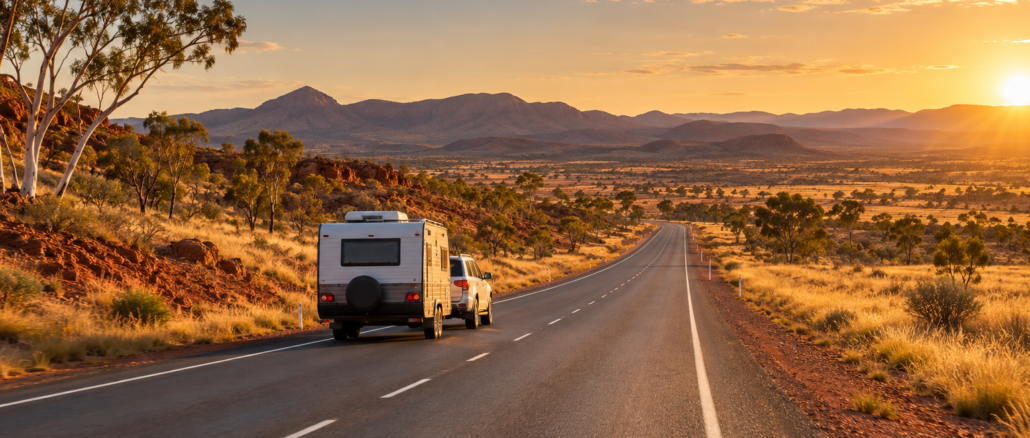
Few things feel more Australian than loading the vehicle, checking the map and heading towards a distant horizon.
The destination matters, but it is rarely the whole story.
The towns, roadhouses, roadside stops and unexpected discoveries become part of the adventure.
Australia is a vast country, and the road trip has become one of the ways we understand it.
When Australians Took to the Road
Australian road holidays expanded rapidly after the Second World War.
Car ownership increased as families became more prosperous and vehicles became more accessible.
Between 1946 and 1955, the number of registered vehicles in Australia more than doubled.
Suddenly, families were no longer restricted to holidays reached by train.
They could pack the car and choose their own route.
The open road became a holiday destination in itself.
The Family Car Was Packed to the Roof
Early road trips were not necessarily comfortable.
Cars lacked air conditioning, highways could be narrow and many country roads were still unsealed.
Luggage was tied to roof racks and children shared the back seat without electronic entertainment.
Families carried water, food, spare tyres and whatever tools they thought might persuade the car to keep going.
Windows were wound down for fresh air.
Maps were unfolded across the passenger seat.
Somebody invariably asked, “Are we there yet?” before the family had left its own suburb.
Caravans Changed Australian Holidays
Caravans gave travellers the freedom to take their accommodation with them.
Holiday parks appeared along the coast and beside major highways.
Families could move from town to town while still having familiar beds, cooking equipment and supplies nearby.
Caravan travel also suited Australia’s great distances.
People were no longer limited to one holiday destination. They could follow the coast, cross the outback or spend weeks travelling between states.
Modern caravans may have bathrooms, solar panels, batteries and satellite internet, but the basic appeal remains unchanged.
Home comes along for the ride.
Motels Became Roadside Landmarks
The rise of the road trip created a new style of accommodation.
Motels allowed motorists to park directly outside their rooms and continue travelling the following morning.
Their bright signs, swimming pools and neat rows of doors became familiar sights on the edges of Australian towns.
For children, spotting a motel pool after a long day in the car could feel like discovering paradise.
For parents, it meant the day’s driving was finally over.
Many older motels remain part of the character of Australia’s highways, even as travel habits continue to change.
The Roadhouse Became an Essential Stop
In remote Australia, the roadhouse is far more than a service station.
It can provide fuel, meals, supplies, local information and a much-needed conversation after hours on an empty road.
Some roadhouses are separated by hundreds of kilometres.
Travellers learn to fill the tank when fuel is available rather than assuming there will be another opportunity just ahead.
The roadhouse meal also became part of the experience.
A burger, toasted sandwich or hot chips can taste remarkably good after a long stretch of highway.
Every Road Trip Has Its Rituals
Australian road trips develop their own traditions.
There is the final check of the house before departure.
The debate over who controls the music.
The first fuel stop, which somehow occurs much sooner than expected.
There are thermoses, travel mugs, bakery stops and snacks that were supposedly packed to last several days.
Drivers lift a finger from the steering wheel to acknowledge passing vehicles on quiet country roads.
Travellers exchange information at rest areas and caravan parks.
Someone coming from the opposite direction often knows more about the road ahead than any brochure.
The Journeys Became Famous
Some Australian roads became destinations in their own right.
The Great Ocean Road follows Victoria’s dramatic coastline.
The Stuart Highway links the south of the continent with the tropical north.
The Nullarbor crossing carries travellers across an enormous stretch of southern Australia.
The Great Barrier Reef Drive winds between rainforest and sea in Far North Queensland.
The Gibb River Road offers a more rugged journey through Western Australia’s Kimberley region.
Each route reveals a different Australia.
There are beaches, forests, mountains, deserts, small towns and horizons that appear to have no end.
The Unexpected Stops Are Often the Best
A road trip rarely goes exactly to plan.
A small sign may lead to a lookout, museum or historic site that was never on the itinerary.
A bakery recommendation can become the highlight of the day.
A roadside conversation may reveal a campsite known mainly to locals.
Australia’s Big Things have also persuaded generations of travellers to make unplanned stops.
It takes considerable determination to drive past a giant prawn without taking a photograph.
These discoveries are why a road trip feels different from simply travelling between two points.
Modern Technology Changed the Journey
Navigation apps have made it more difficult to become completely lost.
Mobile phones provide weather forecasts, accommodation bookings and information about fuel stops.
Modern travellers can carry refrigerators, solar power and communication equipment that earlier generations could hardly have imagined.
Yet technology has not eliminated the need for preparation.
Phone coverage disappears quickly in remote areas. Roads can close after rain, fuel stations can have limited hours and distances remain just as large as they have always been.
Australia still rewards travellers who plan carefully and remain flexible.
More Than a Holiday
The great Australian road trip offers something air travel cannot.
Flying shows the distance between places.
Driving allows you to experience it.
The landscape changes gradually outside the window. Farmland becomes forest, forest becomes scrub and red earth begins appearing beside the road.
Small towns are not dots beneath an aircraft. They become places to stop, eat, explore and meet people.
Travelling by road helps reveal how large and varied Australia really is.
The Road Is Part of the Adventure
The great Australian road trip has changed over the generations.
Vehicles are safer, roads are better and travellers have more technology than ever before.
But the feeling remains familiar.
The vehicle is packed.
The road stretches towards the horizon.
There is somewhere interesting ahead, even if you are not entirely sure what it will be.
That is the joy of an Australian road trip.
Sometimes the best part begins before you arrive.